Free Tools
Simple calculators for focus, habits, and discipline. No sign-up or hidden steps, just clear, practical numbers to help you track your progress.
These tools were built by Serge using established research and public sources. My work focuses on the practical side of focus, habits, and discipline. These tools are for educational purposes and give practical guidance, not professional advice.
Reading about habits and focus only goes so far. These calculators put a number on what you are really doing, so you can see where you stand and what to adjust.
Pick the group that matches what you are working on right now.
Build & Keep Habits

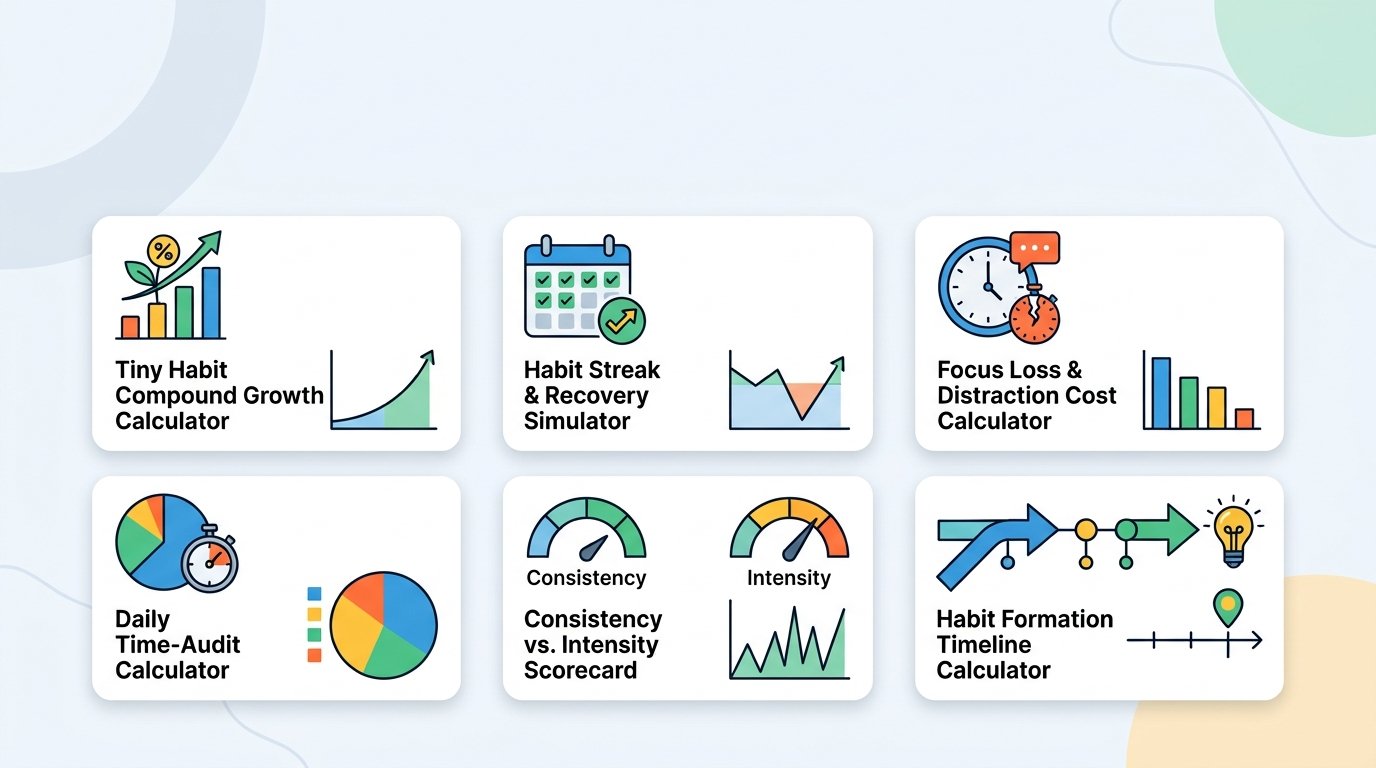
Habit Formation Timeline Calculator
Get a realistic estimate of when a new habit starts to feel automatic.
Use calculator now →
Habit Streak & Recovery Simulator
Check your consistency score and how fast you can rebuild after a missed day.
Use calculator now →
Tiny Habit Compound Growth Calculator
See what a small daily improvement adds up to over weeks and months.
Use calculator now →
Consistency vs. Intensity Scorecard
See if your habits run on steady effort or motivation bursts.
Use calculator now →Focus & Energy

Focus Loss & Distraction Cost Calculator
Find out how many hours interruptions really cost you each week.
Use calculator now →
Focus Session Optimizer
Get a work-and-break split matched to your own attention span.
Use calculator now →
Sleep & Focus Estimator
See how much focus you may be losing to short sleep.
Use calculator now →Time & Goals

Daily Time-Audit Calculator
Log your hours by category and see where your day really goes.
Use calculator now →
Goal Breakdown Calculator
Turn a big goal and a deadline into a clear daily target.
Use calculator now →
Procrastination Cost Calculator
See what putting a task off is really costing you.
Use calculator now →Motivation & Study

Motivation Type Check
Find out if your drive is built to last or likely to fade.
Use calculator now →
Exam Study Plan Builder
Turn your exam date and topics into a day-by-day plan with built-in review.
Use calculator now →How to get the most out of them
A number on its own does not change anything. The point of each tool is to show you a gap, so you can pick one small thing to adjust and repeat it. If a result surprises you, treat it as a starting point rather than a verdict, and pair it with a change you can keep up. Steady effort tends to beat short bursts, which is the idea behind staying motivated day to day and trusting slow, quiet progress.
If you are working on habits
The habit tools pair well with the writing on how habits form and hold. If you are trying to drop something that is not serving you, replacing the habit rather than erasing it tends to stick better. If you slipped, remember that a missed day does not undo your progress, and small, repeated wins build on each other over time. When a habit keeps failing, it sometimes helps to change how you see yourself rather than just forcing the behavior.
If you are working on focus
The focus tools go hand in hand with the practical side of concentration. A lot of focus comes down to timing, so it is worth knowing when your mind is naturally sharpest. For work you would rather avoid, there are ways to stay with boring or hard material, and a surprising amount of lost focus comes from what is sitting on your desk or from not protecting your space the way a bit of deliberate isolation does.
If you are working on motivation and discipline
The scorecards make more sense next to the writing on why effort holds or fades. Discipline is less about raw willpower than what self-discipline really is, and pressure you put on yourself can work against you more than it helps. It also helps to make sure the goals you are chasing are your own, to carve out real time for them, and to understand why routines slip in the first place.
These tools give general educational information. They do not replace personal or professional advice.